
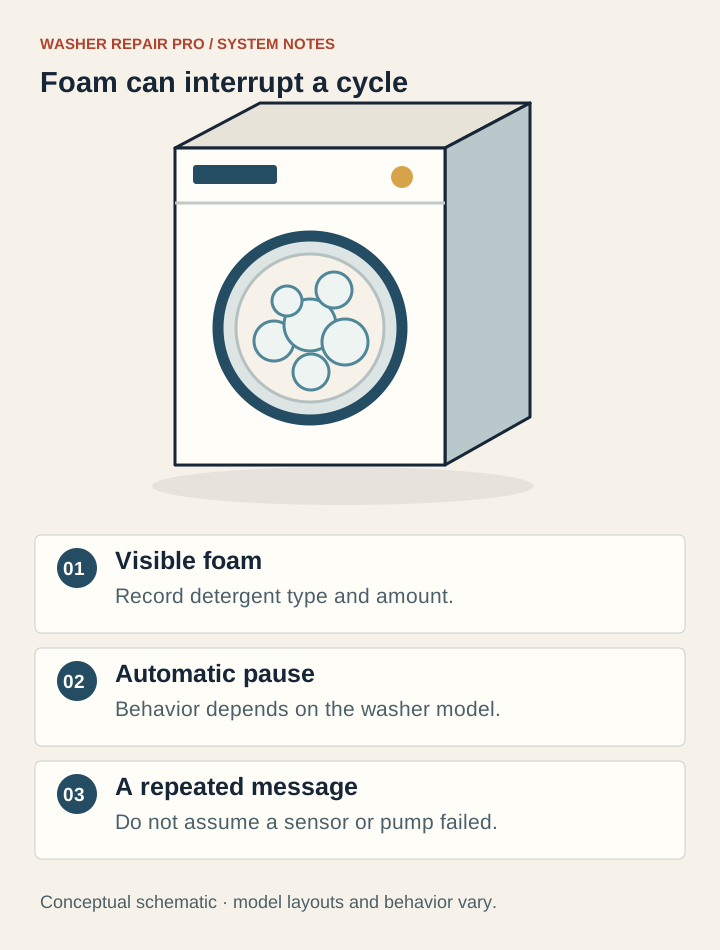
Samsung washer SUd, Sd or 5d reports excessive suds. The washer normally pauses, lets foam settle, and continues automatically. This message by itself does not identify a failed part. Review detergent type and dosing before treating it as a pump or sensor repair.
What the message is responding to
An HE washer needs a low-sudsing detergent in an amount suited to the load. Adding more detergent can create a foam problem rather than improve washing. A suds pause and a reminder displayed after the cycle are different from a machine that cannot fill, drain, or finish at all.
Let the Suds Routine Finish
When SUd first appears, note the time and leave the documented routine to work if the washer is operating safely. Samsung says the cycle should continue after the suds dissipate; the message may flash again at the end as a reminder. That later reminder alone does not mean a new breakdown occurred.
Do not add detergent to a paused load. Repeatedly canceling the cycle makes it harder to tell whether the routine would finish. If water is leaking onto the floor or another code appears, stop treating this as an isolated foam message and record the additional symptom.
HE on the Bottle Is Only the First Check
Samsung requires HE detergent, but an HE label does not make every dose appropriate. Check the product concentration and its directions for this load, then measure what you actually use. The dispenser MAX mark is a limit, not a target that every load needs to reach. Do not exceed it.
Check for a change in detergent brand, concentration, pod count, or who loaded the washer. In a manual dispenser, use the compartment and product form specified for the model. Samsung distinguishes liquid and powder arrangements; its FlexWash upper washer also has separate restrictions. Do not generalize a front-loader drawer demonstration to every Samsung washer.
On a model with automatic dispensing, record both the dose setting and detergent concentration setting. Samsung instructs owners to match those settings to the product. If using pods in an applicable model, check that the filled auto dispenser is turned off so it does not add another dose. Use the manual for the actual controls.
Choose the Next Step From What Actually Happened
Use this observation guide without assigning a failed part. Record visible foam, the exact display, and whether the cycle finishes.
| What happened | Next step |
|---|---|
| SUd paused, then the cycle finished | Review dosing before the next load. |
| New detergent or extra additive preceded the message | Record the exact products and amount; return to approved detergent use. |
| Auto dispense plus a manually added dose | Check both sources of detergent against the model instructions. |
| No completion, another code, or retained water | Record the additional symptom and seek the corresponding support route. |
Dish Soap, Clean Filters, and Advice to Add Vinegar
A Reddit owner reported persistent SUd after dish soap was added to a WF45T6000AW load. They had checked the filter, and their stacked installation limited access. This anecdote supports reporting additives and prior checks; it does not establish a repair.
Do not add dish soap, vinegar, baking soda, oil, or fabric softener as an improvised foam cure. Samsung’s detergent guidance cautions against unsuitable additives. Follow its maintenance guidance and the matching manual for any subsequent empty cleaning cycle; do not import a generic high-temperature cycle or internal hose procedure from a forum.
When Correct Dosing Has Not Resolved the Trouble
Report previous dosing, whether auto dispense remained enabled, visible foam, and whether the cycle completes. The display alone proves neither invisible foam nor a faulty sensor.
Contact Samsung or an appliance technician if the machine remains unable to complete after the documented routine and appropriate detergent checks, especially with an additional fill, drain, or leak symptom. Provide the model suffix and all products used. Ask for a diagnosis of that persistent behavior before approving replacement parts.
Questions owners ask
Are SUd, Sd, and 5d the same Samsung washer message?
Samsung’s US code guide puts these displays in its excessive-suds group, along with 5UD, SUdS, and 5Ud5. Confirm the complete display and appliance model.
How do I reset a Samsung washer SUd error?
Allow the documented suds pause to finish first. A reset does not correct detergent type or amount. If the washer cannot complete, record its behavior and follow model-specific support rather than repeated restarts.
Why does SUd appear when I use HE detergent?
HE detergent can still be over-dosed. Check the measured amount, product concentration, dispenser limit, and any automatic dose added alongside a pod or manual dose.
Will cleaning the pump filter clear SUd?
A clean filter does not answer whether the detergent was suitable or correctly dosed. SUd is a foam indication. Persistent retained water or another drain code needs its own assessment.
Can I add vinegar or more softener to remove the foam?
Do not improvise an additive treatment. Use Samsung’s approved detergent and maintenance instructions for the full model, and tell support if dish soap or another unsuitable product was already added.
Keep the useful details for service
Record the full model, exact display, cycle stage, water location and checks already attempted. Create a repair brief to copy or download. If several symptoms overlap, use the Washer Repair Check without guessing a component.
Related next steps
Sources & model scope
Content reviewed November 5, 2026. Match the exact model and US owner’s manual. These references support the explanation; they are not evidence of an inspection of your machine.
Questions behind this guide
Owner discussions helped identify confusing follow-ups and prior attempts. They are individual experiences; manufacturer information supports the technical explanations above.