
Check the exact manual before judging the water level by sight. High-efficiency machines may use less visible water than expected. A repeated fill alert or a cycle that cannot proceed still needs attention.
Four observations that change the next step
| What you observe | What it can mean | What to record |
|---|---|---|
| Other taps also have low or no water | Household supply condition | Check your utility or building manager’s notice. |
| Only the washer reports a fill alert | Supply to the washer or appliance sensing | Record the code and whether hot/cold behavior differs. |
| Water enters but the level seems low | Model and cycle behavior may explain it | Compare with the exact owner’s manual. |
| The problem followed an installation | Connection or installation context matters | Describe the installation date and changes to the provider. |
Owner checks: stay within the manual
- Record the exact code rather than translating it to “no water.”
- If safe and accessible, visually check whether the washer supply valves appear to be in their normal operating position. Do not force a seized valve.
- Look up the cycle’s normal sensing behavior in the model manual.
- Record any household outage or recent plumbing work. Do not remove pressurized hoses or inlet components as a generic first check.
When to request service
If the household supply is normal but the washer repeatedly cannot fill, request model-specific appliance diagnosis. If the entire property lacks water, contact the utility or building manager first.
What to avoid
Make the call easier
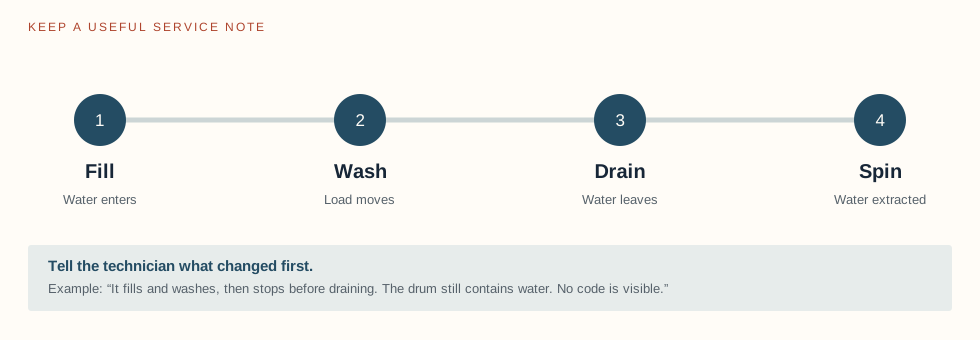
Keep the model, exact code, cycle stage, water location and previous attempts together. Create a copyable service brief before contacting the provider.
A common question
Does a fill code mean the inlet valve is bad?
Not necessarily. Supply conditions, installation, hoses, inlet restrictions and control or sensing conditions can overlap. The code describes a detected condition.
Related next steps
Sources & model scope
Content reviewed November 5, 2026. Match the exact model and US owner’s manual. These references support the explanation; they are not evidence of an inspection of your machine.