Record what was different
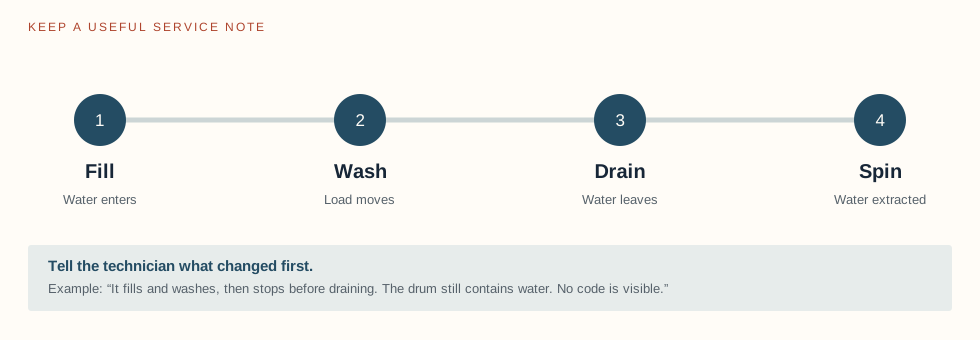
For each event, note the date, selected cycle, load type, exact code, water left in the drum and the point where it stopped. Record existing observations; do not deliberately repeat a risky leak, electrical trip or violent vibration.
Include previous attempts
List a reset, a load change, an owner-manual maintenance check or a replaced part and whether the result lasted. “A new pump did not change the no-drain alert” is useful history without proving which part must be next.
Look for a pattern without inventing a cause
A symptom associated with bulky loads, one cycle or a recent move is a clue to report. It is not proof of a single mechanical failure. Keep observations and your guesses in separate sentences.
Prepare a concise summary
Choose two or three representative events rather than a long unsorted story. Include the model and equipment access. The service-brief tool can turn your notes into a short text document to share with the provider.
Know when to stop collecting data
Active leaks, burning smells, repeated electrical trips or dangerous movement are reasons to stop using the appliance and request appropriate help. You do not need a perfect fault log before doing so.
A fault log the provider can actually use
| Record | Example observation—not a diagnosis | Why it helps |
|---|---|---|
| Cycle stage | Stopped during the drain portion | Narrows the point of the interruption. |
| Display | Photo of exact letters and numbers | Preserves characters that are easy to misremember. |
| Water location | Drum full; no standpipe backup observed | Separates appliance and household drain observations. |
| Frequency | Happened on two of the last three ordinary loads | Describes recurrence without inventing a probability. |
| Earlier attempt | Manual-approved check completed; symptom returned | Avoids repeating the same unhelpful assumption. |